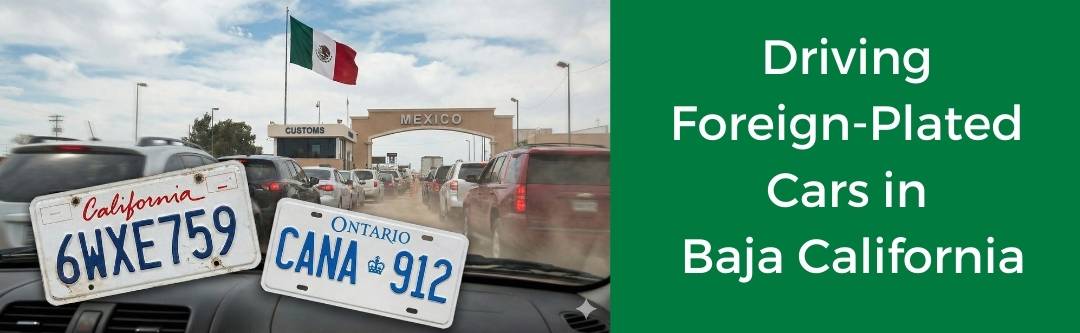
Driving Foreign-Plated Cars in Baja California & Baja California Sur (Including U.S. and Canadian Vehicles)
Driving a foreign-plated vehicle (including U.S. and Canadian plates) in Mexico is legal in specific circumstances. However, legality depends on immigration status, vehicle use, and federal enforcement authority.
This guide explains who may legally drive foreign-plated cars in Baja, why Permanent Residents are treated differently, what has changed in enforcement, and how to remain compliant under Mexican law.
1. The Baja Peninsula as a Free Zone (Zona Libre)
The Baja Peninsula (both Baja California and Baja California Sur) is classified as a Free Zone (Zona Libre) under Mexican customs law.
Traditionally, this allowed certain people to circulate foreign-plated vehicles in Baja without a Temporary Import Permit (TIP), provided the vehicle was legally registered abroad and carried Mexican auto insurance.
This privilege still exists — but only for specific categories of people.
2. The Critical Difference: Tourist vs. Resident
Mexico enforces customs and vehicle laws based on immigration status, not nationality.
3. Who Is Legally Allowed to Drive Foreign-Plated Cars in the Free Zone
According to commonly cited interpretations of Article 106 of the Mexican Customs Law (Ley Aduanera) and related administrative rules, the right to circulate a foreign-plated vehicle in the Free / Border Zone without importing it is generally associated with:
- Foreign tourists (Visitors)
- Temporary Residents (Residente Temporal)
- Mexican nationals residing abroad (who can prove residence outside Mexico)
Permanent Residents (Residente Permanente) are generally treated differently and are often excluded from the Free Zone exception.
Official source:
Ley Aduanera (Customs Law) – PDF
4. Updated Guidance From a Mexican Customs Office: Two Basic Conditions
A written response shared from a Mexican customs office explains two basic conditions for a foreign-plated vehicle to circulate legally:
- The vehicle’s license plates must be current and valid.
- There must be at least one person on board who qualifies as a resident abroad (this person does not necessarily have to be the driver).
Important note: If all occupants of the vehicle are Mexican Permanent Residents, the guidance states that at least one occupant must be able to prove they also maintain residency abroad.
Official source:
Mexican Customs Officer – PDF
Examples of Documents That May Support “Residency Abroad”
The same guidance notes that residency abroad may be accredited through supporting documentation, including but not limited to:
- Employment letter issued abroad
- Recent tax returns filed in another country
- Mortgage documentation
- Utility bills
This documentation is described as being required to demonstrate that at least one person in the vehicle qualifies as a resident outside of Mexico.
5. Foreign Citizens Driving as Tourists
Foreign tourists (including U.S. and Canadian visitors) may drive foreign-plated vehicles in Baja without importing them if:
- The driver is legally in Mexico as a tourist
- The vehicle is not permanently based in Mexico
- The owner or an immediate family member is present
- The vehicle is legally registered abroad
- Mexican auto insurance is carried
6. Foreign Citizens as Mexican Permanent Residents
Once a person becomes a Mexican Permanent Resident (Residente Permanente), Mexico legally considers them a resident of Mexico, not a visitor.
- You may not treat a foreign-plated vehicle as a long-term Mexican car
- You may not keep a foreign-plated vehicle in Mexico permanently
- You may not obtain a Temporary Import Permit (TIP)
- You may not lend the vehicle to a Mexican driver unless you are physically present
Also note: Per the customs-office guidance above, if the vehicle is being used by Permanent Residents, at least one occupant may need to prove they also maintain residency abroad.
7. Why Permanent Residents Lose the Free Zone Privilege
The Free Zone exception is often described as applying to “residents abroad.” Once Permanent Residency is obtained, Mexico becomes your declared permanent home.
For customs and tax purposes, SAT may treat Permanent Residents similarly to Mexican citizens living in Mexico. Any foreign-plated vehicle that lives in Mexico may therefore need to be imported or regularized.
8. Cross-Border Cars vs. Baja-Only Cars
Cross-Border Foreign-Plated Car (Generally Lower Risk)
- The owner is the driver (or is present)
- The vehicle regularly exits Mexico
- The vehicle functions as a foreign vehicle
Baja-Only Foreign-Plated Car (Higher Risk for Permanent Residents)
- Stays full-time in Mexico
- May need to be imported or regularized
- Otherwise may be subject to enforcement actions
9. Regional Enforcement Differences
Baja California (North)
Reports indicate less aggressive enforcement in cities such as San Felipe, Ensenada, and Tijuana. Local authorities generally do not enforce federal customs law.
Baja California Sur
Baja California Sur has seen stricter enforcement, including SAT / Comercio Exterior checkpoints and vehicle detentions based on immigration status.
Relaxed enforcement does not mean legal permission.
10. Why Enforcement Increased (2024–2025)
This is not a new law. What has changed is enforcement. Mexico has increased focus on tax collection, immigration compliance, and closing long-standing loopholes.
11. Legal Solution: Vehicle Regularization (“Autos Chocolate”)
Mexico has extended the vehicle regularization program through September 30, 2026.
- Applies to certain foreign-plated vehicles (typically 2016 or older)
- Approximate cost: $2,500 MXN
- Results in Mexican plates and full compliance
12. Summary
- Foreign-plated vehicles (U.S./Canada) can be legal in Baja depending on immigration status and use
- Customs-office guidance highlights two basic conditions: valid plates and at least one occupant who is a “resident abroad”
- If all occupants are Permanent Residents, at least one may need proof of residency abroad (examples: employment letter, foreign tax returns, mortgage docs, utility bills)
- Enforcement has become stricter in some areas, especially in Baja California Sur
- Legal compliance options exist, including regularization programs for qualifying vehicles
Legal Disclaimer
This content is provided for general informational purposes only and does not constitute legal advice. Mexican customs, immigration, and tax laws are subject to interpretation and enforcement discretion by federal authorities, including the Servicio de Administración Tributaria (SAT). Requirements may vary by circumstances and may change over time.